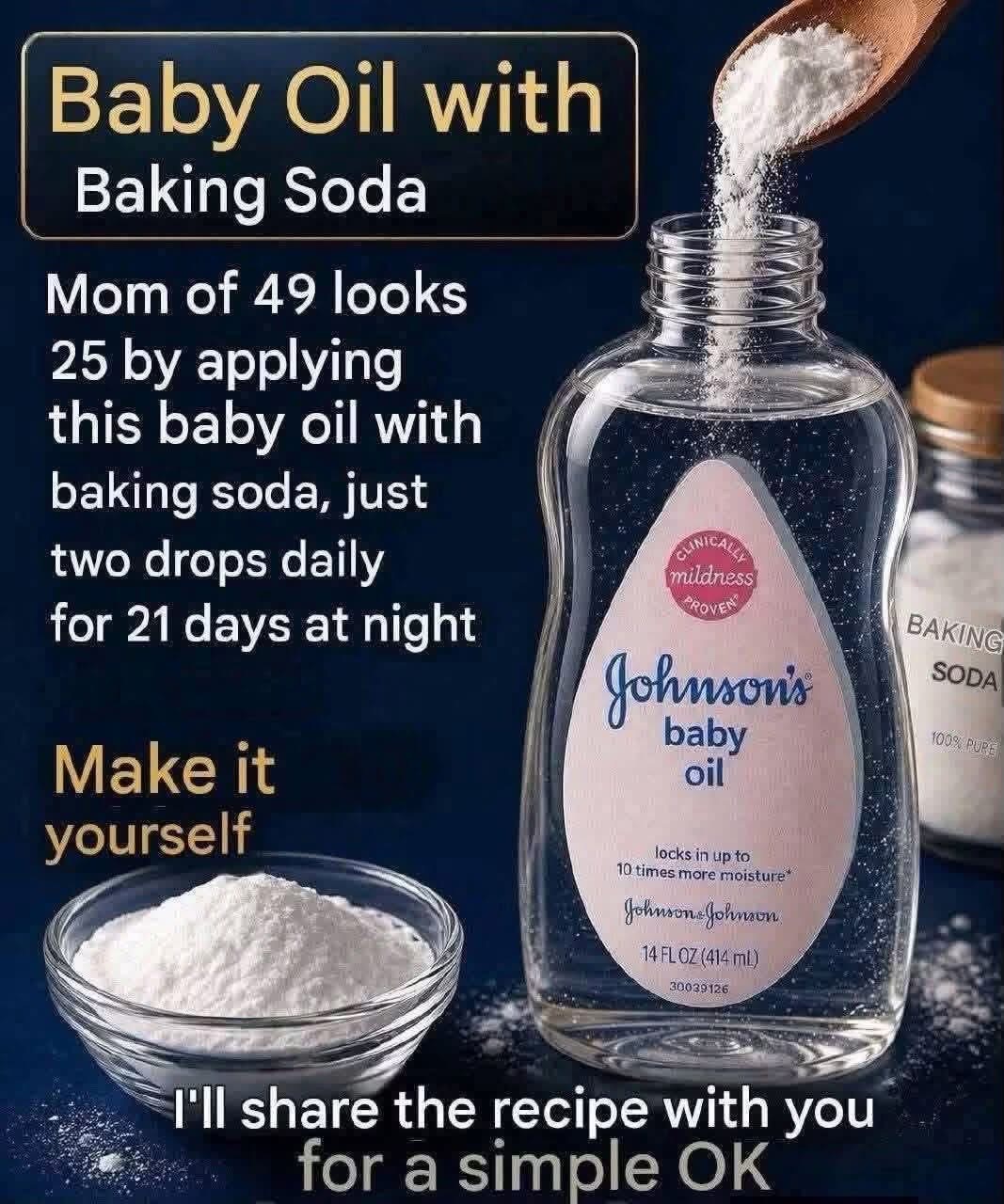
Baby oil and baking soda are two common household products that are often mentioned in homemade skincare routines. Some online beauty posts suggest combining them to make the skin look younger, smoother, or brighter.
However, claims that this mixture can make someone look decades younger or permanently remove wrinkles are not supported as guaranteed results.
The skin has a natural protective barrier, and not every household ingredient is suitable for regular facial use. Baking soda can be particularly irritating for some people, while baby oil is mainly an occlusive product that helps reduce moisture loss from the skin.
If you are interested in simple skincare, understanding how these ingredients work and how to use them cautiously is more important than expecting dramatic overnight results.
What Is Baby Oil
Baby oil is commonly made with mineral oil or similar ingredients designed to help reduce moisture loss from the skin.
Mineral oil forms a protective layer over the skin. This can help keep moisture from escaping, which may leave dry skin feeling softer and smoother.
Baby oil is generally associated with body skincare rather than being a specialized facial anti-aging treatment.
If you want to use baby oil on your face, check the product label and make sure it is appropriate for your intended use.
What Is Baking Soda
Baking soda is also known as sodium bicarbonate.
It is commonly used in cooking, cleaning, and various household applications. Because it is inexpensive and has a fine powder texture, it is sometimes included in homemade exfoliating recipes.
However, facial skin can be sensitive to substances that alter its normal environment.
Baking soda is alkaline, while healthy skin normally has a mildly acidic surface. Frequent or aggressive use of baking soda may contribute to dryness, irritation, or discomfort in some people.
For this reason, baking soda should not automatically be considered a gentle facial skincare ingredient.
Can Baby Oil and Baking Soda Make You Look Younger
There is no reliable basis for promising that a mixture of baby oil and baking soda can make a 49 year old person look 25.
A product that moisturizes the skin can temporarily make dry skin appear smoother. This may make fine lines less noticeable for a short period.
That is very different from permanently removing wrinkles or reversing the aging process.
Age-related changes in the skin are influenced by genetics, sun exposure, collagen changes, facial movement, and many other factors.
No simple homemade mixture can guarantee a dramatic change in appearance.
What Baby Oil Can Do for Dry Skin
Baby oil can be useful for reducing moisture loss from the skin.
When applied to slightly damp skin, an oil-based product can help lock in some of the water already present on the skin’s surface.
This can make dry skin feel softer and more comfortable.
However, baby oil does not replace water-based hydration by itself. It mainly works as an occlusive layer.
If you have very dry skin, a moisturizer formulated for your skin type may be a more practical choice.
Why Baking Soda Can Be Irritating
Baking soda is not formulated specifically for facial skin.
Its alkaline nature can potentially interfere with the skin’s normal protective environment.
Some people may experience:
- Dryness
- Redness
- Tightness
- Burning
- Itching
- General irritation
The risk may be greater when baking soda is used frequently or rubbed aggressively against the skin.
This is one reason why homemade baking soda scrubs should be approached cautiously.
A Safer Approach to Dry Skin
If your main goal is softer and smoother-looking skin, you do not necessarily need baking soda.
A simpler routine can include a gentle cleanser, a suitable moisturizer, and an occlusive product when appropriate.
If you enjoy using baby oil on the body, a small amount can be applied to slightly damp skin after bathing.
This can help reduce moisture loss and leave the skin feeling smoother.
How to Use Baby Oil on the Body
Start with clean skin after a shower or bath.
Gently pat the skin with a towel but leave it slightly damp.
Apply a small amount of baby oil to the hands.
Massage it gently over areas that feel dry.
You do not need a large amount. A thin layer is usually sufficient.
Avoid applying excessive amounts because the skin can feel greasy and the product may transfer onto clothing or surfaces.
Should You Use Baby Oil on Your Face
Baby oil is not automatically the best choice for every face.
Some people may tolerate mineral oil well, while others may prefer facial moisturizers specifically formulated for their skin type.
If you have oily or acne-prone skin, you may prefer a lightweight facial moisturizer instead.
Always check the label of the product you are using and avoid applying it to areas where it causes discomfort or irritation.
What About Wrinkles
Wrinkles are a normal part of skin aging.
Moisturizing can temporarily improve the appearance of dry skin and make the surface look smoother.
However, moisturizing does not mean that wrinkles have been removed.
If your goal is long-term skin care, consistent sun protection is particularly important because ultraviolet exposure contributes to premature visible skin aging.
A simple routine is usually more realistic than relying on one homemade recipe.
Can Baking Soda Remove Dark Spots
Baking soda should not be promoted as a guaranteed treatment for dark spots.
Uneven pigmentation can have many causes, including sun exposure, previous inflammation, hormonal changes, and other factors.
Trying to aggressively scrub dark spots with baking soda can irritate the skin and potentially make some pigmentation concerns more noticeable.
If you have persistent or changing dark spots, professional evaluation is a better option.
Avoid Mixing Baking Soda With Harsh Ingredients
Some homemade skincare recipes combine baking soda with lemon juice, vinegar, or other acidic ingredients.
This is not recommended as a simple facial skincare method.
Combining several potentially irritating ingredients does not guarantee better results.
For sensitive facial skin, keeping your routine simple can reduce the chance of unwanted reactions.
Always Perform a Patch Test
Before trying a new homemade skincare mixture, test a small amount on a limited area of skin.
Do not immediately apply it to your entire face.
Observe how your skin responds.
If you experience burning, swelling, itching, redness, or significant discomfort, wash the area and discontinue use.
A patch test cannot guarantee that irritation will never occur, but it is a useful precaution when trying an unfamiliar product or mixture.
Do Not Apply Baking Soda to Damaged Skin
Never apply baking soda mixtures to open wounds, cuts, sunburned skin, or areas that are already irritated.
Avoid the eyes and lips.
If a product accidentally enters your eyes, rinse them thoroughly with clean water.
Seek medical advice if significant or persistent irritation occurs.
How Often Should You Use Homemade Skincare
Homemade skincare does not need to be used every day.
In particular, baking soda should not become a daily facial scrub.
Frequent exfoliation or rubbing can weaken the skin’s protective barrier and cause discomfort.
For everyday skincare, products specifically designed for facial skin are generally easier to control and formulate with appropriate ingredients.
A Simple Anti Aging Skincare Routine
You do not need dozens of products to maintain healthy-looking skin.
Morning
Gently cleanse your face.
Apply a moisturizer suitable for your skin type.
Use broad-spectrum sunscreen when appropriate.
Evening
Clean your face gently.
Remove makeup and sunscreen.
Apply a moisturizer.
If your skin is very dry, you can use an appropriate occlusive product according to its label.
Consistency is more important than complicated homemade recipes.
Protect Your Skin From the Sun
Sun exposure is one of the major environmental factors associated with visible skin aging.
Regular sun protection can help reduce unnecessary ultraviolet exposure.
When spending time outdoors, use appropriate sunscreen and follow the directions on the product.
Hats, clothing, and shade can also provide additional protection.
A homemade mixture containing baby oil and baking soda cannot replace sunscreen.
Why Before and After Photos Can Be Misleading
Social media posts often use dramatic before-and-after photographs to promote homemade skincare recipes.
However, photographs can look different because of lighting, camera settings, makeup, facial expression, image quality, or editing.
A before-and-after image does not prove that a particular ingredient caused the reported result.
For this reason, skincare content should avoid presenting photographs as guaranteed evidence of a treatment’s effectiveness.
Frequently Asked Questions
Can Baby Oil Remove Wrinkles
Baby oil can help reduce moisture loss and make dry skin feel smoother, but it should not be described as a wrinkle remover.
Does Baking Soda Make Skin Younger
There is no reliable basis for claiming that baking soda reverses skin aging. It can also irritate some people’s skin.
Can I Use Baby Oil Every Night
Whether baby oil is appropriate for regular use depends on your skin and the product. If you use it, follow the product directions and stop if irritation occurs.
Can Baking Soda Remove Dark Spots
Baking soda is not a proven guaranteed treatment for dark spots. Aggressive use may irritate the skin.
Can I Mix Baby Oil With Baking Soda
Although this combination appears in homemade beauty recipes, there is no need to use it as a routine facial treatment. Baking soda may cause irritation, particularly with repeated use.
Can This Recipe Make Someone Look 25 Again
No. A homemade skincare mixture cannot guarantee that someone will look decades younger. Claims like this should be treated as advertising or social media exaggeration rather than a proven skincare result.
Final Thoughts
Baby oil and baking soda are common household products, but they have very different properties.
Baby oil can help reduce moisture loss and may leave dry body skin feeling softer. Baking soda, on the other hand, can be irritating when applied to sensitive facial skin, especially when used frequently or as a scrub.
The claim that combining these ingredients can make someone dramatically younger or eliminate wrinkles should not be presented as a guaranteed result.
For a simple skincare routine, focus on gentle cleansing, regular moisturizing, and protection from excessive sun exposure. If you want to experiment with a new product or homemade preparation, introduce it cautiously and stop using it if irritation develops.
Healthy-looking skin does not require a miracle recipe. A consistent routine and realistic expectations are a much better approach.