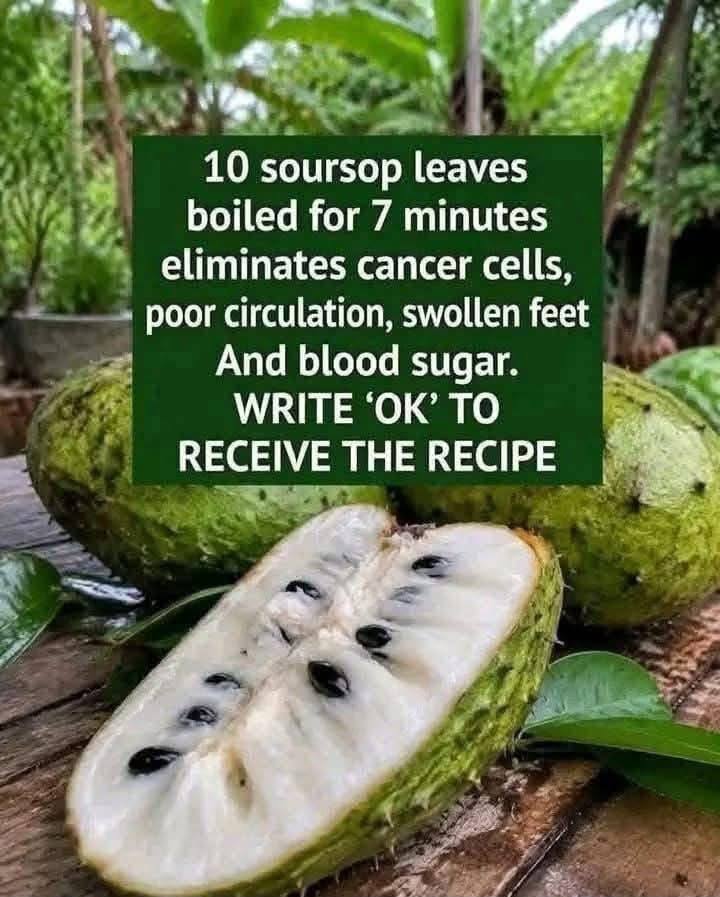
Soursop is a tropical fruit that has attracted considerable attention because of its distinctive appearance, sweet and tangy flavor, and traditional use in herbal medicine. The fruit is commonly known as soursop, while it is also called graviola or guanabana in different parts of the world.
In recent years, social media posts have promoted soursop leaves as a natural remedy for several health conditions. One popular claim suggests that boiling 10 soursop leaves for seven minutes can eliminate cancer cells, improve poor circulation, reduce swollen feet, and lower blood sugar.
Although soursop has been studied by researchers, these claims should be approached carefully. There is a significant difference between traditional use, laboratory research, animal studies, and treatments that have been proven effective in human clinical trials.
Soursop contains naturally occurring plant compounds that are scientifically interesting. However, current evidence does not establish that a simple soursop leaf tea can cure cancer, diabetes, circulation problems, or swollen feet.
What Is Soursop
Soursop comes from the tropical plant Annona muricata. It produces a large green fruit with soft white flesh and black seeds.
The fruit is consumed in many tropical regions and can be eaten fresh or used in juices, smoothies, desserts, and other foods. The leaves have traditionally been used to prepare herbal teas and other preparations.
Different parts of the plant contain different naturally occurring compounds. Researchers have investigated these compounds because some have demonstrated biological activity in laboratory experiments.
However, the fact that a plant contains biologically active compounds does not automatically mean that consuming it as a tea will treat a disease.
The way a substance behaves in a laboratory can be very different from how it behaves inside the human body.
Why Soursop Leaves Have Become Popular
Soursop leaves have been used traditionally in several cultures for generations. Social media has increased interest in these traditional practices by presenting simple recipes and claims about their potential health benefits.
One common recipe involves washing several soursop leaves, placing them in water, boiling them for a short period, and drinking the resulting liquid.
The problem is that viral posts often present these preparations as proven treatments for serious illnesses.
Claims such as eliminating cancer cells or curing diabetes require strong scientific evidence. A traditional recipe or personal testimonial cannot establish that a treatment works.
Can Soursop Leaves Eliminate Cancer Cells
The claim that soursop leaves can eliminate cancer cells is one of the most widely shared claims about the plant.
Researchers have studied extracts from soursop and have found that certain compounds can affect cancer cells under laboratory conditions.
These findings are scientifically interesting and may help researchers understand whether some compounds could eventually have medical applications.
However, laboratory research does not prove that drinking soursop leaf tea can eliminate cancer in humans.
Cancer treatment requires evidence from carefully designed human studies. Researchers need to determine whether a substance works in people, what dose is appropriate, how it should be administered, what side effects it may cause, and whether it provides meaningful benefits compared with established treatments.
A substance that affects cancer cells in a laboratory dish may not produce the same effect inside the human body.
For this reason, soursop leaf tea should not be considered a proven cancer treatment.
Laboratory Research Does Not Mean Cancer Cure
This distinction is extremely important when reading health information online.
Many plants contain compounds that show activity against cancer cells in laboratory experiments. Researchers investigate these compounds because they may provide clues for future drug development.
But a laboratory result is only an early step in the research process.
A compound may work against isolated cells but fail to reach the necessary concentration in the human body. It may also be broken down during digestion or produce unwanted effects before it can have the desired effect.
Therefore, statements claiming that soursop leaves “kill cancer” can be misleading if they fail to explain that much of the research is preliminary.
People with cancer should never replace chemotherapy, radiation therapy, surgery, immunotherapy, targeted therapy, or other prescribed treatments with soursop leaf tea.
Can Soursop Leaves Lower Blood Sugar
Another popular claim is that soursop leaves can lower blood sugar.
Researchers have investigated the possible effects of soursop preparations on glucose levels, particularly in laboratory and animal studies.
Some preclinical findings have suggested that compounds from the plant may influence blood glucose. However, these results do not provide enough evidence to recommend soursop leaf tea as a treatment for diabetes.
Diabetes is a medical condition that requires appropriate monitoring and treatment.
People who already take medication to lower blood sugar should be especially careful with herbal preparations that may have similar effects. Combining different substances without professional guidance could potentially result in blood sugar becoming too low.
Anyone with diabetes should follow the treatment and dietary advice provided by their healthcare professional.
Soursop and Blood Sugar Research
It is understandable why people are interested in natural foods and plants that may influence blood sugar.
However, controlling blood glucose is more complicated than simply consuming one type of tea.
Blood sugar is affected by diet, physical activity, medications, body composition, stress, sleep, hormones, and many other factors.
Even if a plant compound appears promising in laboratory research, scientists still need human clinical studies to determine whether it produces a reliable and safe effect.
Until stronger evidence is available, soursop leaf tea should not be promoted as a replacement for established diabetes care.
Can Soursop Improve Poor Circulation
The image also claims that soursop leaves can improve poor circulation.
There is currently insufficient evidence to establish that drinking soursop leaf tea is an effective treatment for circulation problems.
Poor circulation can have many different causes. It may be associated with problems involving the arteries or veins, diabetes, cardiovascular disease, blood clots, inactivity, or other medical conditions.
Because the causes are different, treatment also depends on the underlying problem.
Symptoms such as persistent cold feet, numbness, pain while walking, changes in skin color, or unusual swelling should not simply be treated with an herbal drink.
A healthcare professional can help determine the cause and recommend appropriate treatment.
Can Soursop Leaves Reduce Swollen Feet
Swollen feet and ankles are another symptom frequently mentioned in online claims about herbal remedies.
There are many possible reasons for swelling.
Temporary swelling can sometimes occur after sitting or standing for a long time, during hot weather, or after certain activities. However, persistent swelling may sometimes be associated with problems involving the heart, kidneys, liver, veins, or other conditions.
There is not enough scientific evidence to establish that soursop leaf tea can treat swollen feet.
If swelling continues or repeatedly occurs, identifying the cause is more important than simply trying to reduce the symptom.
Sudden swelling, especially if it occurs mainly in one leg, deserves medical attention. Swelling accompanied by chest pain, difficulty breathing, severe pain, or other serious symptoms requires prompt evaluation.
Is Seven Minutes of Boiling Scientifically Proven
The viral image specifically recommends boiling 10 soursop leaves for seven minutes.
There is no established clinical evidence showing that this exact recipe is a medically proven treatment for cancer, diabetes, poor circulation, or swollen feet.
The amount of compounds released from leaves during boiling can depend on many factors.
These factors may include the size and age of the leaves, their freshness, the amount of water used, the temperature, and the length of time they are boiled.
Consequently, a homemade drink does not have a standardized concentration of active compounds.
The number 10 and the seven-minute boiling time should therefore not be presented as a scientifically established medical dosage.
Soursop Fruit Is Different From Soursop Leaves
It is important to distinguish between eating soursop fruit and drinking preparations made from its leaves.
Soursop fruit is a food and can be included in a varied diet. It contains naturally occurring nutrients and plant compounds.
Leaf preparations are different because the leaves contain different substances and may expose the body to compounds in different concentrations.
The same distinction applies to extracts, capsules, powders, and other concentrated products.
A food consumed as part of a normal diet should not automatically be considered equivalent to a concentrated herbal preparation.
Possible Safety Concerns
Natural products are not automatically risk free.
Soursop contains biologically active compounds, and researchers have raised questions about the potential effects of certain compounds found in the plant, particularly with prolonged or concentrated exposure.
There may also be interactions with medications.
For example, people taking medication for diabetes or blood pressure may need to be cautious because herbal preparations can potentially influence these measurements.
Anyone taking prescription medication should discuss regular use of soursop leaf products with a qualified healthcare professional.
People with existing medical conditions should also avoid assuming that a natural remedy is safe simply because it is traditionally used.
Who Should Be Particularly Careful
People with diabetes should be cautious about using soursop leaf preparations because of the possibility of effects on blood sugar.
People taking blood pressure medication should also seek professional advice before regularly consuming concentrated preparations.
People receiving cancer treatment should tell their oncology team about any herbal products they are considering.
Pregnant or breastfeeding individuals should also seek professional medical advice before using herbal preparations because safety information for many products can be limited.
Anyone preparing to use a herbal product regularly should consider the possibility of medication interactions and other individual risk factors.
Should Soursop Leaves Replace Medical Treatment
Soursop leaves should not replace medical treatment.
This is particularly important for serious conditions such as cancer, diabetes, cardiovascular disease, kidney disease, and vascular disorders.
Modern medical treatments are selected based on the individual’s diagnosis, medical history, test results, and the severity of the condition.
For cancer, for example, treatment may involve surgery, chemotherapy, radiation therapy, immunotherapy, targeted treatment, hormone therapy, or combinations of different approaches.
Stopping or delaying proven treatment because of an online claim about a herbal tea can have serious consequences.
A healthy food or traditional beverage can be part of someone’s lifestyle without being considered a cure.
How to Evaluate Health Claims on Social Media
Health information on social media should always be evaluated carefully.
A post may contain an attractive image, a simple recipe, and a confident statement about treating several diseases. None of these things prove that the claim is medically accurate.
Before believing a health claim, ask several questions.
Was the research conducted in humans?
Was the exact preparation tested?
How many people participated?
Was there a control group?
Was the study published in a reputable scientific journal?
Have independent researchers confirmed the findings?
Are the possible side effects known?
Can the product interact with medication?
These questions can help distinguish genuine scientific evidence from exaggerated claims.
Why Personal Testimonials Are Not Enough
Online posts often include comments from people saying that a particular herbal drink made them feel better.
Personal experiences can be meaningful to the person who experienced them, but they cannot prove that a treatment works.
A person may improve naturally, receive other treatments at the same time, change their diet, or experience symptoms that fluctuate over time.
Scientific studies are designed to account for these factors and determine whether a treatment produces a consistent effect.
This is why medical recommendations are based on evidence from properly conducted research rather than individual testimonials.
A Balanced Approach to Soursop
There is no need to view soursop as either a miracle cure or a useless plant.
It is reasonable to recognize that researchers have found interesting compounds in the plant and that soursop has a long history of traditional use.
At the same time, it is important not to make claims that go beyond the available evidence.
Soursop fruit can be enjoyed as a food, while the use of soursop leaves as a regular herbal preparation should be approached more carefully.
The most responsible approach is to enjoy nutritious foods while relying on established medical care when treating disease.
Healthy Habits Matter More Than One Food
Overall health is influenced by many lifestyle factors.
A balanced diet containing vegetables, fruits, whole grains, legumes, nuts, seeds, and appropriate sources of protein can provide a wide range of nutrients.
Regular physical activity, adequate sleep, avoiding tobacco, maintaining a healthy weight, and attending appropriate medical checkups can also contribute to long-term health.
No single tea, fruit, vegetable, or herbal preparation can provide all of these benefits.
Instead of searching for one food that promises to solve several health problems at once, it is generally better to build healthy habits that can be maintained over time.
Frequently Asked Questions
Can soursop leaves cure cancer
There is not enough reliable human clinical evidence to show that soursop leaves can cure cancer. Laboratory research into compounds from soursop is interesting, but it does not establish soursop leaf tea as a cancer treatment.
Can I drink soursop leaf tea instead of cancer treatment
No. People with cancer should not replace prescribed treatment with soursop leaf tea. Anyone considering herbal products during cancer treatment should discuss them with their medical team.
Can soursop leaves lower blood sugar
Some preclinical research has investigated possible blood sugar effects, but this does not establish soursop leaves as a proven diabetes treatment. People taking diabetes medication should consult a healthcare professional before using them regularly.
Does boiling 10 leaves for seven minutes work
There is no established clinical evidence that this exact recipe treats cancer, diabetes, circulation problems, or swollen feet.
Can soursop leaves improve circulation
There is insufficient evidence to conclude that soursop leaf tea can treat poor circulation. Persistent circulation symptoms should be evaluated to determine their underlying cause.
Can soursop leaves reduce swollen feet
There is insufficient evidence to establish soursop leaves as a treatment for swollen feet. Persistent or unexplained swelling should be medically evaluated.
Is soursop fruit the same as soursop leaf tea
No. The fruit is a food, while leaves contain different plant compounds. Concentrated leaf preparations should therefore not automatically be considered equivalent to eating the fruit.
Is natural medicine always safe
No. Natural substances can have biological effects, side effects, and interactions with medications. Safety depends on the substance, amount, frequency of use, and individual health circumstances.
Final Thoughts
Soursop is a nutritious tropical fruit with a long history of traditional use, and researchers continue to study compounds found in different parts of the plant.
Some laboratory research has produced interesting findings, particularly regarding compounds that may affect cells under experimental conditions. However, these findings should not be confused with proof that soursop leaf tea can cure cancer.
The claim that boiling 10 soursop leaves for seven minutes can eliminate cancer cells, improve circulation, reduce swollen feet, and lower blood sugar is not supported by sufficient human clinical evidence.
Soursop fruit can be enjoyed as part of a balanced diet, but concentrated leaf preparations should be approached with caution. People taking medication or living with a medical condition should speak with a healthcare professional before using soursop leaves regularly.
The most important point is simple: promising laboratory research is not the same as a proven medical treatment.
Healthy foods can support a healthy lifestyle, but serious medical conditions require proper diagnosis and evidence based care.