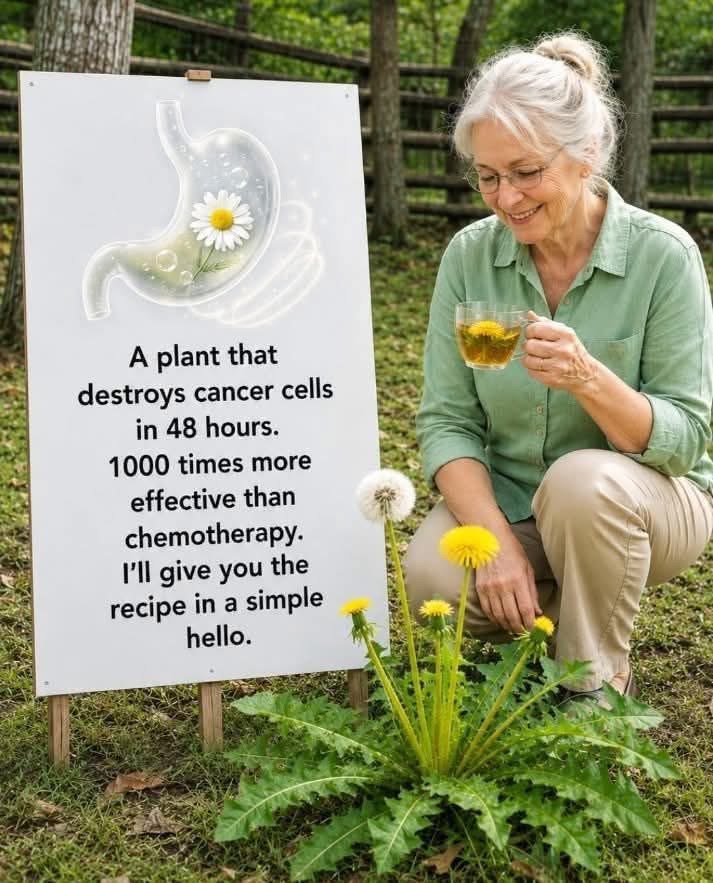
Dandelion is a common plant that has been used in traditional herbal practices for generations. It is often consumed as a tea, added to salads, or prepared in different forms as a herbal product. In recent years, social media posts have promoted dandelion as a powerful natural treatment for cancer, sometimes claiming that it can destroy cancer cells within 48 hours or work hundreds or even thousands of times better than chemotherapy.
These statements can sound convincing, especially when they are accompanied by scientific-looking images or references to laboratory studies. However, there is an important difference between something showing an effect in laboratory experiments and something being proven to treat cancer in people.
So, can dandelion really fight cancer? The answer requires looking carefully at what scientific research has actually found.
What Is Dandelion
Dandelion is a flowering plant commonly known by its scientific name Taraxacum officinale. Different parts of the plant, including the leaves and roots, have traditionally been used in foods and herbal preparations.
Dandelion contains several naturally occurring compounds, including antioxidants and other plant chemicals that researchers have studied for their biological effects.
It can be consumed as a food or prepared as tea. Dandelion root is also available in some herbal supplements and concentrated extracts.
The fact that a plant contains potentially active compounds does not automatically mean that it can treat a serious disease. Scientists need to establish whether those compounds work in humans, at what dose, whether they are safe, and whether they provide benefits that are greater than their risks.
Why Dandelion Became Associated With Cancer Research
Interest in dandelion and cancer largely comes from laboratory research.
Scientists have studied dandelion extracts in cancer cells grown in laboratories. Some experiments have reported that certain dandelion extracts can affect cancer cells, including processes associated with cell death.
These findings are interesting and may help researchers understand whether compounds found in plants could eventually contribute to the development of new medicines.
However, laboratory findings should not be confused with evidence that a plant can cure cancer in humans.
A substance can kill cancer cells in a laboratory dish while having little or no effect when consumed by a person. The body must absorb, distribute, process, and eliminate the substance, and the concentration that reaches a tumor may be very different from the concentration used in a laboratory experiment.
What Does the 48 Hour Claim Mean
One of the most frequently repeated claims about dandelion says that it can destroy cancer cells in 48 hours.
This statement is based on laboratory research involving specific dandelion extracts and cancer cells.
In some experiments, researchers observed significant effects on certain cancer cell lines after exposure to dandelion root extract for a particular period of time.
That does not mean that drinking dandelion tea will destroy cancer cells inside a human body within 48 hours.
The experiment conditions are completely different from normal human consumption.
Researchers may use a concentrated extract under carefully controlled laboratory conditions. A person drinking a cup of tea does not necessarily receive the same compounds or concentration.
This distinction is extremely important when evaluating health claims found online.
Laboratory Research Is Not the Same as Human Treatment
Cancer research generally progresses through several stages.
Scientists may first study a substance in isolated cells. If the results are promising, researchers may conduct studies in animals. If the treatment continues to appear promising and safe, it may eventually be tested in carefully designed human clinical trials.
Only after sufficient clinical evidence can researchers determine whether a treatment is genuinely effective for patients.
Dandelion research has produced interesting laboratory findings, but that is not enough to establish dandelion as a cancer treatment.
There is currently no reliable clinical evidence showing that drinking dandelion tea or taking dandelion products can cure cancer.
What About the Claim That Dandelion Is Better Than Chemotherapy
Another viral statement claims that dandelion is hundreds or thousands of times more effective than chemotherapy.
There is no good scientific evidence supporting this comparison.
Chemotherapy refers to a large group of medicines that have been extensively studied in clinical trials and are used to treat many different types and stages of cancer. Different chemotherapy drugs work in different ways, and their effectiveness depends on the particular cancer and treatment plan.
Comparing a laboratory plant extract directly with chemotherapy is misleading.
A laboratory experiment involving cancer cells cannot establish that a plant is more effective than a cancer medicine in patients.
It also cannot determine whether the plant improves survival, reduces tumor recurrence, or helps patients live longer.
Can Dandelion Tea Be Part of a Healthy Diet
For many people, dandelion used as a food or a traditional tea may be perfectly reasonable.
However, consuming a plant as part of a normal diet is very different from using a concentrated herbal extract as a medical treatment.
Dandelion leaves can be eaten, and dandelion products are available in various forms. Some people use dandelion tea as a caffeine-free herbal beverage.
The important point is to have realistic expectations.
Dandelion tea should not be considered a cancer medicine simply because laboratory research has found biological activity in dandelion extracts.
Dandelion and Antioxidants
Dandelion contains compounds with antioxidant properties, which is one reason researchers have investigated it.
Antioxidants are substances that can help protect cells from certain types of oxidative damage. Fruits, vegetables, herbs, and many other foods contain antioxidants.
However, the presence of antioxidants does not mean that a particular food or herb can prevent or cure cancer.
Cancer is a complex group of diseases involving genetic changes, cellular signaling, immune responses, environmental factors, and many other processes.
Eating a varied diet rich in vegetables, fruits, whole grains, and other nutritious foods can support overall health, but no individual food should be presented as a cure for cancer.
Is Dandelion Safe
Dandelion is generally considered a food ingredient, but concentrated herbal products can behave differently from ordinary foods.
People who are taking medications should be especially careful with herbal supplements.
Dandelion may potentially interact with certain medications, including some medicines affecting blood sugar, blood clotting, or fluid balance.
People with allergies to related plants may also need to exercise caution.
Pregnant or breastfeeding individuals, people with chronic medical conditions, and anyone taking regular medication should discuss the use of concentrated herbal products with a healthcare professional.
Natural does not automatically mean risk free.
Why Cancer Patients Should Be Especially Careful
Cancer treatment is often complex and may involve surgery, radiation therapy, chemotherapy, targeted therapy, immunotherapy, hormone therapy, or combinations of these treatments.
Some patients may want to add natural products because they hope to reduce side effects or improve their chances of recovery.
The problem is that certain herbal products can interact with medications or affect how treatments work.
For this reason, anyone receiving cancer treatment should tell their doctor or pharmacist about herbal teas, supplements, extracts, and other complementary products they are considering.
Most importantly, an unproven herbal remedy should never be used as a replacement for prescribed cancer treatment.
Delaying effective treatment while waiting for a natural remedy to work can have serious consequences.
Why Social Media Claims Can Be Misleading
Health information spreads quickly online, particularly when it promises a simple solution to a serious disease.
A post may say that a plant has been shown to kill cancer cells and then present the statement as proof that the plant cures cancer.
The missing information is often the most important part.
Was the research performed in humans?
What type of cancer was studied?
Was the research performed in a laboratory?
What concentration was used?
Was the product tested for safety?
Did the study measure tumor growth in people or only changes in isolated cells?
Without these details, a scientific-sounding statement can create a completely misleading impression.
What Research Can Actually Tell Us
The existing research on dandelion is interesting because certain extracts have demonstrated biological activity in laboratory studies.
Researchers have investigated dandelion extracts in different experimental cancer models, including studies involving cancer cells.
These experiments may help scientists identify compounds worth studying further.
But laboratory research is only an early step.
It does not establish that dandelion tea can treat cancer, and it does not prove that dandelion is superior to established cancer therapies.
More research, particularly high-quality human clinical trials, would be needed before any therapeutic claim could be made.
Should You Drink Dandelion Tea
If you enjoy dandelion tea as a beverage, it may be reasonable for many healthy adults when consumed appropriately.
But it should be viewed as a beverage or traditional herbal product rather than a cancer treatment.
If you have cancer or another serious medical condition, discuss herbal products with your healthcare team before using concentrated extracts or supplements.
Your doctor can consider your diagnosis, medications, treatment plan, and overall health when determining whether a particular product is appropriate.
A Better Approach to Cancer Prevention
Instead of relying on one plant or one homemade drink, cancer prevention involves a broader approach to health.
Important habits can include avoiding tobacco, maintaining a healthy body weight, staying physically active, eating a balanced diet, limiting alcohol, protecting the skin from excessive ultraviolet exposure, and following recommended screening guidelines.
These strategies do not guarantee that someone will never develop cancer, because cancer has many causes and risk factors. However, they can contribute to better overall health and may reduce the risk of certain cancers.
The Bottom Line
Dandelion is an interesting plant that contains biologically active compounds, and laboratory research has investigated its potential effects on cancer cells.
However, laboratory findings are not the same as proof of a cancer treatment.
There is no reliable evidence that drinking dandelion tea can destroy cancer cells in humans within 48 hours. There is also no credible evidence that dandelion is hundreds or thousands of times more effective than chemotherapy.
The most responsible way to view dandelion is as a food or herbal product that may be the subject of future scientific research, not as a proven cancer cure.
Anyone diagnosed with cancer should work with qualified healthcare professionals and should not replace or delay evidence-based cancer treatment because of claims circulating on social media.
Frequently Asked Questions
Can dandelion cure cancer
There is currently no reliable evidence showing that dandelion can cure cancer in humans. Some laboratory studies have found interesting effects from specific dandelion extracts, but these findings do not prove that the plant is an effective cancer treatment.
Does dandelion kill cancer cells in 48 hours
Certain laboratory experiments have reported effects on cancer cells after exposure to dandelion extracts for specific periods. This does not mean that drinking dandelion tea kills cancer cells in a human body within 48 hours.
Is dandelion better than chemotherapy
There is no scientific evidence establishing that dandelion is more effective than chemotherapy. Such comparisons are misleading because laboratory plant extracts and clinically tested cancer medicines are evaluated in very different ways.
Can cancer patients drink dandelion tea
Some people may be able to consume dandelion as a food or tea, but cancer patients should discuss herbal products with their healthcare team. Possible interactions with medications need to be considered.
Is dandelion safe for everyone
Not necessarily. Safety can depend on the form, amount, individual health conditions, allergies, and medications being used. Concentrated supplements deserve more caution than ordinary food amounts.
What should someone do after a cancer diagnosis
Anyone diagnosed with cancer should speak with an appropriately qualified healthcare professional about the diagnosis and available treatment options. Herbal products should not be used to replace or delay recommended medical care.
Final Thoughts
Natural products can be valuable subjects of scientific research, and many modern medicines have been developed from compounds originally found in plants. That does not mean every traditional remedy is automatically an effective treatment.
Dandelion deserves continued scientific investigation, particularly because some early laboratory findings are interesting. At the same time, health information should remain grounded in the strength of the available evidence.
For now, dandelion can be enjoyed as a food or herbal beverage by people for whom it is appropriate, but claims that it rapidly cures cancer or dramatically outperforms chemotherapy are not supported by reliable human evidence.
Medical Disclaimer: This article is for general educational purposes only and is not a substitute for professional medical advice, diagnosis, or treatment. Anyone with cancer or another serious health condition should consult a qualified healthcare professional before starting an herbal supplement or changing an existing treatment plan.