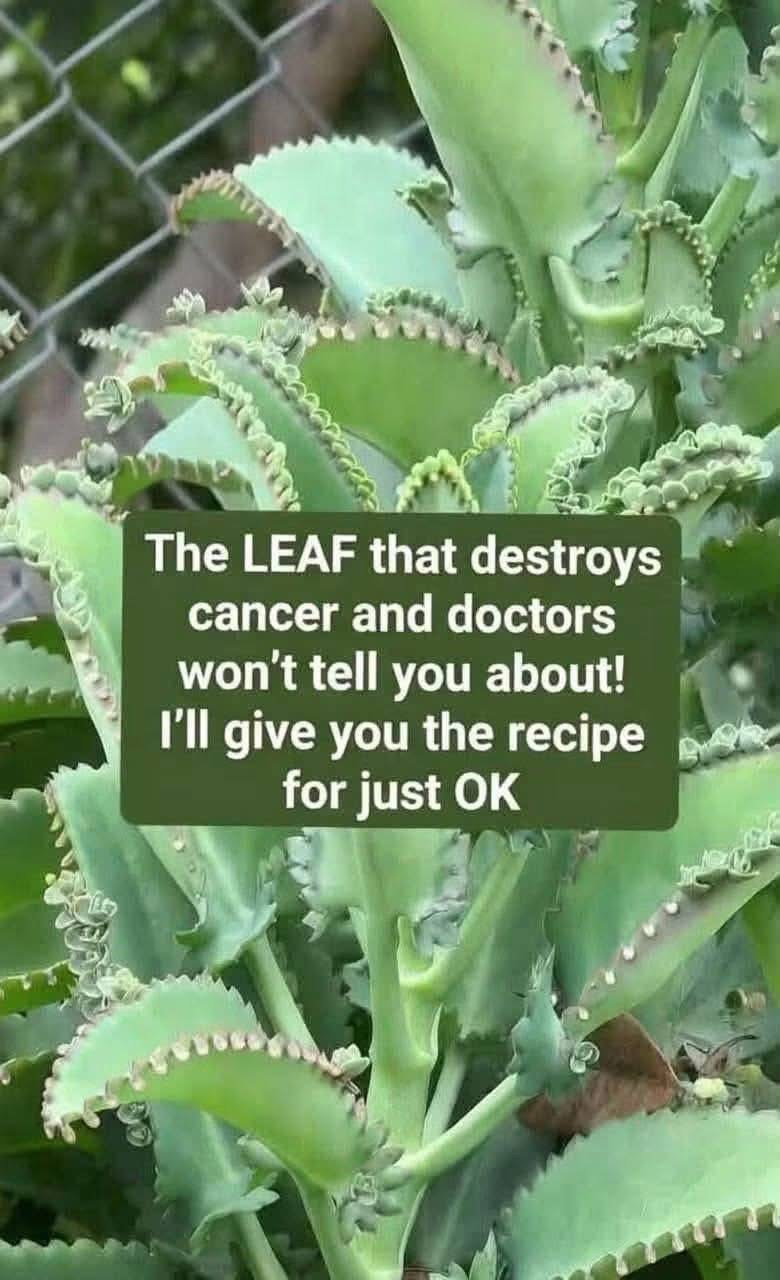
Kalanchoe pinnata is a unique succulent plant known for its thick green leaves and the tiny plantlets that can grow along the edges of its leaves. Because of this unusual ability to reproduce, the plant is often called the mother of thousands, life plant, air plant, or Bryophyllum pinnatum.
The plant has been used traditionally in different parts of the world, and researchers have investigated its natural compounds and possible biological properties. In recent years, Kalanchoe pinnata has also received significant attention online because of claims about its potential effects on serious diseases.
Some social media posts describe Kalanchoe leaves as a natural way to destroy cancer. However, such statements go beyond what current scientific evidence can establish. Laboratory research can be interesting and promising, but it does not prove that consuming the plant can cure cancer in humans.
This article looks at Kalanchoe pinnata, its traditional uses, the compounds found in the plant, its potential properties, and the important safety considerations to understand before using it.
What Is Kalanchoe Pinnata
Kalanchoe pinnata is a succulent species belonging to the Crassulaceae family. Its scientific name is also commonly associated with the name Bryophyllum pinnatum.
The plant is recognizable because of its fleshy leaves and its ability to produce small plantlets around the leaf margins. These plantlets can eventually develop roots and grow into new plants.
Kalanchoe pinnata grows particularly well in warm climates and can be found in many tropical and subtropical regions.
It is commonly cultivated as an ornamental plant because it is relatively easy to grow and has an unusual appearance.
Why Kalanchoe Pinnata Has Attracted Attention
Kalanchoe pinnata has a long history of traditional use. Different communities have used various parts of the plant in traditional preparations for a variety of purposes.
The plant has also attracted scientific interest because it contains several naturally occurring compounds. Researchers have investigated flavonoids, phenolic compounds, organic acids, triterpenes and bufadienolides found in Kalanchoe species.
These compounds may have biological activity, which is one reason scientists continue to study the plant.
However, the presence of biologically active compounds does not automatically mean that consuming the whole plant provides a medical benefit.
Natural Compounds Found in Kalanchoe Pinnata
Plants contain many different chemical compounds, and their concentration can vary depending on the species, growing conditions and part of the plant being studied.
Kalanchoe pinnata contains several groups of phytochemicals that have attracted scientific attention.
Flavonoids
Flavonoids are naturally occurring plant compounds found in many fruits, vegetables and herbs.
Some flavonoids have antioxidant properties in laboratory experiments. Researchers have therefore investigated flavonoids from Kalanchoe species to better understand their possible biological effects.
Phenolic Compounds
Phenolic compounds are another important group of plant chemicals. They are widely studied because some members of this group can interact with free radicals and other biological molecules.
Their presence contributes to the scientific interest surrounding Kalanchoe pinnata.
Bufadienolides
Bufadienolides are compounds that deserve particular attention because they can have powerful biological effects.
Research into Kalanchoe species has found bufadienolide compounds with interesting laboratory activity. At the same time, these compounds may also have toxic effects, particularly on the cardiovascular system.
This is one reason why it is not appropriate to assume that concentrated Kalanchoe extracts or homemade preparations are automatically safe.
Traditional Uses of Kalanchoe Pinnata
Kalanchoe pinnata has been used in traditional medicine in several regions.
Traditional preparations have included fresh leaves, juices, crushed leaves and other forms of plant material.
Depending on the culture and region, the plant has been traditionally associated with various uses, including applications involving the skin and other health concerns.
Traditional use can be an important starting point for scientific research because it may help researchers identify plants and compounds worth investigating.
However, traditional use alone does not establish that a treatment is effective or safe according to modern medical standards.
Kalanchoe Pinnata and Antioxidant Research
One area of interest is the antioxidant activity of compounds found in Kalanchoe plants.
Antioxidants are substances that can interact with reactive molecules. Many plants contain antioxidant compounds, which is one reason researchers investigate them as potential sources of useful natural products.
Laboratory antioxidant activity, however, should not be interpreted as proof that a plant can prevent or cure a particular disease.
The human body is complex, and the effects of a compound in a laboratory test may be very different from its effects after being consumed.
Kalanchoe Pinnata and Inflammation Research
Scientists have also investigated the potential effects of Kalanchoe extracts on biological pathways associated with inflammation.
Some experimental findings have been interesting enough to encourage additional research.
Nevertheless, laboratory findings do not establish that drinking Kalanchoe juice or eating its leaves can treat an inflammatory condition.
More research, especially well-designed human studies, would be necessary before making reliable medical recommendations.
Kalanchoe Pinnata and Cancer Research
Cancer is the subject that has generated some of the strongest claims about Kalanchoe pinnata online.
Some laboratory studies have examined Kalanchoe extracts and compounds against cancer cell lines.
Researchers have reported activity against certain types of cultured cancer cells. These experiments can help scientists understand whether particular compounds deserve further investigation.
However, there is an important distinction between killing cancer cells in a laboratory and treating cancer in a human patient.
A laboratory experiment does not demonstrate that consuming Kalanchoe leaves will produce the same effect inside the human body.
The amount of a compound needed in a laboratory may also be impossible or unsafe to achieve through normal consumption.
Why Laboratory Research Does Not Prove a Cancer Cure
When scientists study a plant extract in the laboratory, they can control many variables.
They can determine the concentration of an extract, expose specific cells to it and observe what happens.
A human body is very different.
After a substance is consumed, it must pass through the digestive system, be absorbed, distributed through the body and metabolized. It may also interact with medications or affect healthy tissues.
For a plant compound to become an accepted cancer treatment, researchers generally need evidence from several stages of scientific investigation, including carefully designed clinical studies.
Therefore, promising laboratory findings should be considered a reason for further research, not proof of a cure.
Is Kalanchoe Pinnata Safe
Safety is an important consideration whenever a medicinal plant is used.
People sometimes assume that natural plants are automatically safe. This is not always true.
Plants can contain powerful chemicals, and some natural compounds can cause side effects or toxicity when consumed in sufficient quantities.
Kalanchoe species contain bufadienolides, which are compounds that can affect the cardiovascular system.
Because of this, consuming large amounts of Kalanchoe preparations or using concentrated extracts without professional guidance may carry risks.
Why Homemade Kalanchoe Recipes Can Be Difficult to Control
Online articles and social media posts sometimes recommend preparing Kalanchoe leaves as tea, juice or another homemade remedy.
One problem with homemade preparations is the lack of standardized dosing.
The concentration of active compounds can vary between plants. It can also depend on the age of the leaves, growing conditions, plant species and preparation method.
A recipe that uses a certain number of leaves therefore does not necessarily provide a predictable amount of a particular compound.
This makes homemade preparations difficult to evaluate for both effectiveness and safety.
Can You Eat Kalanchoe Leaves
The fact that a plant is edible in some traditional contexts does not necessarily mean that every preparation or amount is safe.
Kalanchoe species can differ in their chemical composition, and some contain compounds that may have toxic effects.
For this reason, people should be cautious about consuming Kalanchoe leaves based solely on information found on social media.
Anyone considering using the plant internally, especially in concentrated forms, should first consult a qualified healthcare professional.
Kalanchoe Pinnata Should Not Replace Medical Treatment
People living with cancer or another serious medical condition should not replace prescribed medical care with an unproven herbal preparation.
Cancer treatment can involve surgery, radiation therapy, chemotherapy, immunotherapy, targeted treatments or other approaches depending on the individual diagnosis.
Delaying an effective treatment while relying on an unproven remedy can have serious consequences.
Kalanchoe research may be valuable for future scientific discoveries, but it should not currently be presented as an alternative to established cancer care.
Possible Benefits Being Studied
Scientific interest in Kalanchoe pinnata includes several areas.
Researchers have investigated its antioxidant properties, potential effects on inflammatory pathways and biological activity associated with certain plant compounds.
Some laboratory studies have also examined the effects of Kalanchoe extracts on cultured cancer cells.
These areas are worth researching because plants can sometimes provide compounds that later become useful starting points for pharmaceutical development.
However, research findings should always be interpreted according to the type and quality of evidence available.
How to Understand Claims About Natural Remedies
When reading claims about Kalanchoe or any other medicinal plant online, it is useful to ask a few basic questions.
Was the research performed on humans or only on cells?
Was the study performed using the whole plant or a purified compound?
Was the research conducted in animals, a laboratory or a clinical setting?
Was the study large enough to produce reliable results?
Has the result been independently reproduced?
These questions can help distinguish genuine scientific evidence from exaggerated health claims.
Frequently Asked Questions
Does Kalanchoe pinnata destroy cancer?
There is no sufficient clinical evidence to conclude that Kalanchoe pinnata destroys or cures cancer in humans. Some laboratory research has investigated Kalanchoe extracts and cancer cells, but these findings do not establish the plant as a cancer treatment.
What is Kalanchoe pinnata traditionally used for?
The plant has been used traditionally in different regions for several purposes, including various preparations involving the leaves. Traditional uses vary considerably between cultures.
Is Kalanchoe pinnata a medicinal plant?
Kalanchoe pinnata has a history of traditional medicinal use and contains biologically active compounds that researchers continue to study. This does not mean that every traditional use has been scientifically confirmed.
Can Kalanchoe replace cancer treatment?
No. Kalanchoe should not be used as a replacement for established cancer treatment.
Why are people talking about Kalanchoe and cancer?
Interest has partly resulted from laboratory research showing biological activity from certain Kalanchoe extracts and compounds. Online posts can exaggerate these findings and turn preliminary research into unsupported claims about cancer cures.
Is natural medicine always safe?
No. Natural substances can have powerful effects and may cause side effects, toxicity or interactions with medications. Safety depends on the specific substance, dose, preparation and individual circumstances.
Final Thoughts
Kalanchoe pinnata is an unusual and interesting plant with a long history of traditional use. Its distinctive leaves and ability to produce small plantlets have also made it popular as an ornamental plant.
Scientists continue to study the compounds found in Kalanchoe species, including flavonoids, phenolic compounds and bufadienolides. Laboratory research has produced interesting findings, including research involving antioxidant activity and certain cancer cell lines.
However, these findings should not be confused with proof that Kalanchoe pinnata can cure cancer.
The safest way to understand this plant is to recognize the difference between traditional use, laboratory research and clinically proven medical treatment.
If you are considering using Kalanchoe pinnata for a health condition, particularly cancer or another serious disease, discuss it with a qualified healthcare professional before using it.