Onions are a common and nutritious ingredient found in kitchens around the world. They contain vitamins, minerals, sulfur-containing compounds, and other plant compounds that can be part of a healthy diet.
However, social media posts sometimes turn ordinary foods into supposed miracle treatments for serious eye conditions.
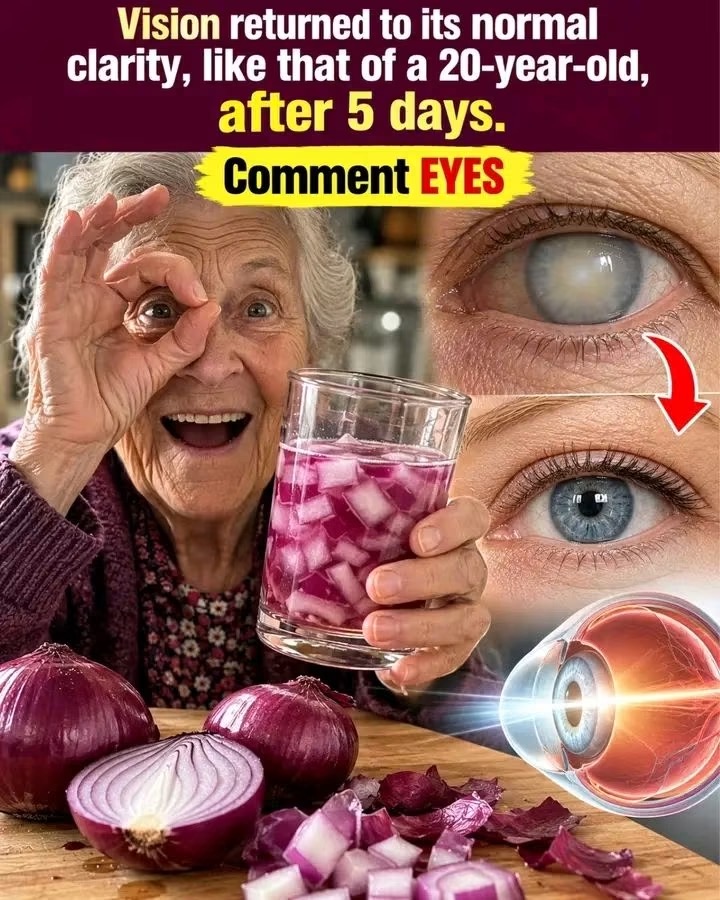
One viral image claims that drinking a preparation made with red onions can restore normal vision in just five days, making an older person’s eyesight “like that of a 20-year-old.” The image also shows an eye with a cloudy appearance that supposedly becomes clear after using the remedy.
This claim may look convincing, but there is an important difference between eating a nutritious food and treating an eye disease.
There is currently no established medical evidence that drinking onion juice, onion water, or another homemade onion preparation can remove cataracts or restore normal vision within five days.
Understanding why this claim is misleading can help people make safer decisions about their eyesight.
What Is a Cataract
A cataract occurs when the natural lens inside the eye becomes cloudy.
The lens is normally clear and helps focus light onto the retina. As a cataract develops, the lens becomes less transparent, which can make vision blurry, hazy, or less colorful.
Cataracts are particularly common with aging, although they can also develop for other reasons, including certain medical conditions, eye injuries, previous eye surgery, and some medications.
The National Eye Institute explains that cataracts can cause blurry vision, faded colors, sensitivity to light, difficulty seeing at night, and sometimes double vision.
Because cataracts usually develop gradually, people may not notice the changes immediately.
Can Onion Juice Cure Cataracts
There is no established evidence that onion juice can cure an existing cataract.
A cataract is not simply a nutritional deficiency that can be washed away by drinking a particular vegetable juice. It involves clouding of the eye’s natural lens.
According to the National Eye Institute, surgery is currently the only way to get rid of a cataract.
This does not mean onions are unhealthy.
Onions can be part of a balanced diet and contain useful plant compounds. But the fact that a food contains beneficial nutrients does not mean that it can reverse an established eye disease.
Why the Five Day Claim Is Not Supported
The viral image says that vision returns to normal after only five days.
This is an extremely specific medical promise, and claims like this require strong clinical evidence.
There is no established treatment in which drinking onion juice removes cataracts in five days.
Cataracts involve physical changes to the natural lens. If the lens becomes cloudy enough to interfere with vision, an eye specialist needs to determine whether the vision problem is actually caused by a cataract and whether treatment is necessary.
The NHS states that cataract surgery is the way to remove a cataract and replace the cloudy lens with an artificial lens.
Therefore, a social media recipe should not be presented as a replacement for an eye examination or established treatment.
Can Eating Onions Support Eye Health
Eating onions can be part of a healthy diet.
A varied diet that includes vegetables, fruits, leafy greens, whole grains, nuts, and other nutritious foods can provide the body with a wide range of nutrients.
The National Eye Institute recommends healthy food choices, including fruits and vegetables, leafy greens, nuts, and whole grains, as part of habits that support eye health.
However, supporting eye health is different from treating cataracts.
For example, eating vegetables regularly may contribute to good nutrition, but it does not mean that an existing cataract will disappear.
This distinction is important because many online health claims start with a true statement about nutrition and then make an unsupported medical conclusion.
Onion Is Not an Eye Medicine
Onions contain many natural compounds, and researchers have studied different compounds found in onions for various biological effects.
But laboratory research should not automatically be interpreted as proof that eating onions can treat a disease.
There is a major difference between:
“Onions contain beneficial plant compounds.”
and:
“Drinking onion water removes cataracts in five days.”
The first statement describes a food.
The second is a medical treatment claim that requires clinical evidence.
Without appropriate human clinical studies demonstrating that the treatment works safely and consistently, the second claim should not be treated as established medical advice.
What Happens When a Cataract Develops
The natural lens contains proteins that can change as people age.
Over time, these changes can cause the lens to become cloudy.
As the cataract becomes more advanced, people may experience:
- Cloudy or blurry vision
- Difficulty seeing at night
- Increased glare from headlights
- Colors appearing faded
- Difficulty reading
- Frequent changes in glasses prescriptions
- Problems with everyday activities
The National Eye Institute describes these as common symptoms of cataracts.
The exact symptoms and their severity vary from person to person.
Do Cataracts Always Require Immediate Surgery
No.
A person can have an early cataract without needing surgery immediately.
The National Eye Institute explains that early cataracts may sometimes be managed with measures such as brighter lighting, anti-glare sunglasses, magnifying lenses, or updated glasses. Surgery may be recommended when cataracts begin interfering with activities such as reading, driving, or watching television.
This is an important point because people sometimes believe that a cataract diagnosis automatically means immediate surgery.
The decision depends on how much the cataract affects vision and daily life.
Regular eye examinations can help monitor the condition.
What Is Cataract Surgery
Cataract surgery removes the cloudy natural lens and replaces it with an artificial lens called an intraocular lens.
The procedure is commonly performed with local anesthesia.
According to the NHS, cataract surgery usually takes around 20 to 45 minutes, and most people can return home the same day.
The National Eye Institute also explains that the cloudy lens is removed and replaced with an artificial lens.
After surgery, vision may initially be blurry while the eye recovers. Eye drops are commonly prescribed during recovery.
As with any medical procedure, cataract surgery has potential risks, but it is a well-established treatment for cataracts.
Can Onion Water Improve Blurry Vision
Blurry vision can have many different causes.
It may be associated with cataracts, refractive errors, dry eyes, diabetic eye disease, glaucoma, retinal problems, or other conditions.
This is why it is not safe to assume that every episode of blurry vision is caused by a cataract.
If someone drinks onion water and later notices that their vision seems better, that does not prove that the drink removed a cataract.
Vision can fluctuate for many reasons, and the original problem may not have been a cataract at all.
An eye examination is the appropriate way to determine the cause.
Do Not Put Onion Juice Directly Into Your Eyes
Another potential problem with viral onion remedies is the possibility that people may interpret the recipe as an instruction to put onion juice directly into the eyes.
This should be avoided.
The eye is a sensitive organ, and homemade liquids are not sterile ophthalmic preparations.
Onion juice can cause irritation, burning, watering, and inflammation if it comes into direct contact with the eye.
More importantly, homemade preparations can contain microorganisms or contaminants.
A substance being natural does not automatically make it safe for the eyes.
Products intended for use in the eye must be specifically formulated for ophthalmic use.
Why Natural Does Not Always Mean Safe
“Natural” is often used in social media marketing as if it means “safe.”
That is not necessarily true.
Plants contain powerful chemical compounds. Some can be beneficial, while others can irritate the skin or eyes, interact with medications, or cause allergic reactions.
The safety of a substance depends on:
- The amount used
- How it is prepared
- How it enters the body
- The person’s health
- Other medications being taken
- Whether the product is sterile
- Whether its effects have been studied in humans
This is particularly important for anything being placed directly into the eye.
Can Diet Prevent Cataracts
A healthy lifestyle can support general health and may help reduce certain risk factors associated with eye disease.
The National Eye Institute recommends protecting the eyes from excessive sunlight, avoiding smoking, protecting the eyes from injury, and making healthy food choices.
However, prevention and treatment are not the same thing.
Even people who eat a healthy diet can develop cataracts as they age.
There is no food that guarantees a person will never develop a cataract.
Protecting Your Eyes as You Age
There are several practical habits that can support long-term eye health.
Protect Your Eyes From Sunlight
Wearing sunglasses that provide appropriate UV protection and using a hat with a brim can reduce exposure to strong sunlight.
Avoid Smoking
Smoking is associated with several health problems, including eye conditions. Quitting smoking can benefit overall health.
Eat a Varied Diet
Include a wide variety of fruits, vegetables, leafy greens, whole grains, nuts, and other nutritious foods.
Protect Your Eyes From Injury
Safety glasses can be important when working with power tools, chemicals, or other materials that could injure the eyes.
Have Regular Eye Examinations
Eye examinations can identify cataracts and other conditions that may affect vision.
The National Eye Institute recommends regular dilated eye examinations, particularly as people get older.
Why Viral Eye Remedies Can Be Dangerous
The biggest problem with miracle eye remedies is not necessarily the food itself.
The danger is that someone may delay proper medical care.
Suppose an older person develops blurry vision and assumes it is simply a cataract. They find a viral onion recipe and decide to use it for several weeks.
If the actual problem is glaucoma, retinal disease, diabetic eye disease, or another condition, delaying examination could be harmful.
The NHS notes that different causes of vision loss require different treatments.
This is why persistent or changing vision should be evaluated rather than self-diagnosed from a social media image.
Sudden Vision Changes Need Urgent Attention
Not every vision problem should be attributed to cataracts.
Sudden changes in vision can sometimes indicate an urgent eye condition.
Seek urgent medical attention if you suddenly develop:
- A sudden increase in floaters
- Flashes of light
- A dark curtain or shadow across your vision
- Sudden blurred vision
- Significant eye pain
- Sudden loss of vision
The NHS specifically warns that sudden flashes, increased floaters, a dark curtain or shadow, and sudden blurred vision can be signs of serious retinal problems.
These symptoms should not be treated with a homemade drink.
What the Viral Image Gets Wrong
The image contains several claims that are not supported by established medical evidence.
The statement that vision can return to the clarity of a 20-year-old after five days is not a proven medical outcome of drinking onion preparations.
The picture also implies that the cloudy appearance of a cataract can simply disappear after consuming onions.
Current guidance from the National Eye Institute and NHS does not support this. Cataract surgery is the established way to remove an existing cataract.
This does not mean onions have no nutritional value.
It simply means that nutritional value should not be confused with a proven cataract treatment.
Frequently Asked Questions
Can red onion cure cataracts?
No established evidence shows that red onion or red onion juice can cure an existing cataract.
Can onion juice restore vision in five days?
There is no established clinical evidence that onion juice can restore normal vision within five days.
Can drinking onion water remove a cloudy lens?
There is no proven medical treatment involving onion water that removes the cloudy lens of an eye.
Is eating onions good for your eyes?
Onions can be part of a balanced diet and provide plant compounds and nutrients. However, eating onions should not be considered a treatment for cataracts.
Should onion juice be put into the eyes?
No. Homemade onion juice is not a sterile ophthalmic medicine and can irritate or injure the eye.
Is cataract surgery always necessary immediately?
No. Early cataracts may not interfere enough with daily activities to require immediate surgery. An eye doctor can monitor the cataract and discuss treatment when necessary.
What is the proven treatment for cataracts?
Surgery is currently the established treatment that removes an existing cataract. The cloudy natural lens is replaced with an artificial lens.
Can healthy food improve eye health?
A balanced diet can support overall health and provide nutrients important for the body. However, healthy food should not be presented as a guaranteed cure for an existing eye disease.
Final Thoughts
Onions are nutritious foods that can easily be included in a healthy diet, but the viral claim that onion juice can restore normal vision in five days is not supported by established medical evidence.
Cataracts involve clouding of the natural lens inside the eye. When a cataract becomes significant enough to affect daily activities, cataract surgery is the established treatment for removing the cloudy lens.
Healthy eating, protecting your eyes from excessive sunlight, avoiding smoking, preventing eye injuries, and having regular eye examinations are sensible ways to care for your vision.
Most importantly, do not put homemade onion juice or other kitchen ingredients directly into your eyes.
If your vision is becoming blurry, cloudy, or suddenly changing, the safest step is to have your eyes examined by a qualified eye-care professional rather than relying on a viral recipe.
Key Takeaways
- There is no established evidence that onion juice cures cataracts.
- The claim that vision returns to normal in five days is not medically established.
- Onions can be part of a healthy and varied diet.
- Eating onions is different from using onions as an eye treatment.
- Homemade onion juice should not be placed directly into the eyes.
- Cataracts cause clouding of the natural lens inside the eye.
- Early cataracts may sometimes be managed with better lighting, anti-glare measures, magnification, or updated glasses.
- Cataract surgery is currently the established way to remove an existing cataract.
- Sudden vision changes require prompt medical assessment.
- Viral health claims should be checked against reliable medical sources before being followed or shared.
Health Disclaimer
This article is for general educational purposes only. It does not diagnose, treat, cure, or prevent any disease. If you have cataracts, blurry vision, eye pain, sudden vision changes, or another eye condition, consult a qualified eye-care professional. Do not put homemade onion juice, plant extracts, oils, or other non-approved substances into your eyes.